

The real cost of workplace stress
And the proven returns of fixing it

prime-aged workers (25-54) are exhausted at work³
Burnt-out employees are 2.6 times more likely to actively seek a new job³
of resignations cite burnout as the primary reason³
quit without another job lined up³

What burnout actually does to your people
Every day in Australia, 47% of workers go home exhausted¹. Not tired. Exhausted. The kind of bone-deep depletion that sleep doesn’t fix and weekends don’t cure.
The statistics paint a brutal picture. 82% of Australian workers report feeling burnt out - the highest rate in the world². Among those, 36% describe themselves as very or extremely burnt out². These aren’t just numbers. They’re resignation letters being drafted, relationships strained, and talented people choosing unemployment over another day at their desk.
What it’s costing your bottom line
Workplace stress costs Australian businesses $14 billion annually through absenteeism alone³. But that’s just the obvious cost.
Presenteeism (when employees show up but can’t function) costs the economy $34.1 billion annually⁴. Every employee loses 6.5 working days per year to presenteeism⁴. They’re at their desk, but they’re not working. They’re surviving.
.webp)
more sick leave taken by stressed employees compared to healthy colleagues⁴
lost annually by Australian businesses to stress-related absenteeism alone¹
is all that unhealthy employees can manage effectively per month³
of all workplace absences can be traced back to job-related stress⁵
What it does to workplace culture
When burnout becomes normal, everything breaks. 36% of organisations do nothing to address employee burnout⁸. Of those that try, 56% of HR departments don't even encourage conversations about it⁸.
The result is workplaces where stress is contagious, talent hemorrhages, and "that's just how it is here" becomes the motto.
of organisations do nothing to address employee burnout⁸
of Australian workers report feeling stressed, the highest rate globally¹¹
of HR departments don’t encourage burnout conversations at all⁸
Presenteeism costs 3-4 times more than absenteeism⁴
What happens when you actually address it
Australian organisations implementing workplace massage and wellness programs see immediate, measurable change. This isn’t wishful thinking. It’s documented fact.
%20copy.webp)
decrease in sick leave absenteeism¹¹
return on investment for every dollar spent on employee wellbeing¹¹
reduction in the cost of workers compensation¹¹
reduction in employee risk factors¹²
Productivity gains for days
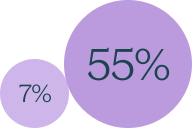
Employee engagement increases from 7% to 55% with proper wellness¹⁰

Healthy employees are 3x more productive than unhealthy ones⁵
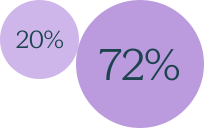
Self-reported creativity jumps from 20% to 72%¹⁰
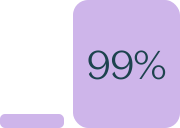
99% participation rates in workplace massage programs¹³
Because we’re not making this stuff up
Every statistic on this page comes from legitimate Australian research institutions, government bodies, and peer-reviewed studies. Here’s where we got the numbers…


TELUS Mental Health Index surveyed over 3,000 Australian workers in 2024, making it one of the most comprehensive recent studies on workplace mental health. This independent research tracks mental health trends across multiple countries and industries.
Key Finding: 47% of Australian workers feel exhausted every single day.
Source: https://www.telushealth.com/en-au/press-releases/telus-mental-health-index-australia-april-2024/
This research by Diversity Australia and UiPath analysed workplace burnout across multiple countries, comparing Australian data against global benchmarks across various industries and demographics.
Key Finding: 82% of Australian workers experience burnout - the highest rate globally.
Source: https://www.diversityaustralia.com.au/understanding-burnout-a-global-and-australian-perspective/
Foremind's comprehensive analysis of Australian workplace data examined the relationship between employee burnout and turnover intentions across multiple sectors and company sizes.
Key Findings: 2.6x more likely to quit when burnt out; 40% of resignations cite burnout as the primary reason; 28% quit without another job lined up.
Source: https://foremind.com.au/employee-burnout-statistics/
Landmark study of 3,620 Australian workers examining the relationship between employee health and workplace productivity. Participants were assessed across multiple health metrics and their productivity was measured objectively.
Key Findings: Healthy employees work 143 effective hours per month vs 49 hours for unhealthy employees; unhealthy employees take up to 9x more sick days.
Source: https://www.medibank.com.au/livebetter/newsroom/post/healthy-employees-are-three-times-more-productive
Comprehensive literature review analysing workplace stress costs across European Union member states, with methodology applicable to Australian workplace contexts.
Key Finding: 50-60% of all lost working days are caused by work-related stress.
Source: https://publications.europa.eu/resource/cellar/c8328fa1-519b-4f29-aa7b-fd80cffc18cb.0001.01/DOC_1
AIHW's ongoing Mental Health Online Report provides comprehensive data on Australia's mental health system, including workplace-related mental health statistics drawn from national datasets.
Key Finding: Mental health conditions are the second most common work-related health problem in Australia.
Source: https://www.aihw.gov.au/mental-health
Comprehensive analysis examining the business case for workplace health and wellbeing programs, reviewing multiple Australian case studies and international research.
Key Finding: $5.81 return for every dollar invested in workplace wellness programs.
Source: http://www.comcare.gov.au/__data/assets/pdf_file/0006/99303/Benefits_to_business_the_evidence_for_investing_in_worker_health_and_wellbeing.pdf
The Chapman Institute's extensive research documented across hundreds of workplace wellness programs, with findings validated by Australian government agencies including SafeWork NSW and SafeWork SA studies on workplace health program effectiveness.
Key Findings: 25% reduction in sick leave absenteeism; 40.7% reduction in workers compensation costs; $5.81 return for every $1 invested in workplace wellness programs; SafeWork SA found programs can decrease staff absenteeism by an average of 30%.
Sources:
- Chapman Institute: https://chapmaninstitute.com/
- SafeWork SA: https://www.safework.sa.gov.au/workers/health-and-wellbeing/healthy-workers-and-workplaces
- SafeWork NSW mental health ROI studies: https://www.thriveatwork.org.au/resources/business-case/economic/
Comprehensive inquiry into mental health examining the economic impact of mental illness and the effectiveness of various interventions, including workplace programs.
Key Finding: Mental illness costs the Australian economy over $200 billion annually, with significant workplace productivity impacts.
Source: https://www.pc.gov.au/inquiries/completed/mental-health/report
State of the Global Workplace report based on over 2 million employee surveys worldwide, measuring engagement, wellbeing, and productivity across countries and industries.
Key Finding: Only 23% of global workers are engaged at work; Australian engagement rates are similarly low.
Source: https://www.gallup.com/workplace/349484/state-of-the-global-workplace.aspx
Analysis of Australian workplace wellbeing data synthesising multiple government and industry sources to assess the current state of workplace wellness in Australia.
Key Finding: Poor mental health costs Australian workplaces $10.9 billion annually in direct costs.
Source: https://www.oncoreservices.com/news-resources/is-australia-in-a-workplace-wellbeing-crisis
Comprehensive study examining the relationship between employee wellness programs and workplace productivity, analysing ROI data from multiple organisational implementations.
Key Finding: For every dollar invested in workplace wellness, organisations see between $3-6 return on investment.
Source: Referenced in Vitality Works analysis: https://vitalityworks.health/resources/science-wellbeing
Corporate massage provider Stress Recess reported participation data across their nationwide workplace massage programs, tracking employee uptake rates across multiple corporate clients.
Key Finding: Employer-funded workplace massage programs consistently achieve participation rates of 95% and above, significantly outperforming typical workplace wellness program participation rates of 40-50%.
Source: Slavin, D., AHC Media (Relias Media), 2000: https://www.reliasmedia.com/articles/45713-massage-service-sees-95-participation-rate
